
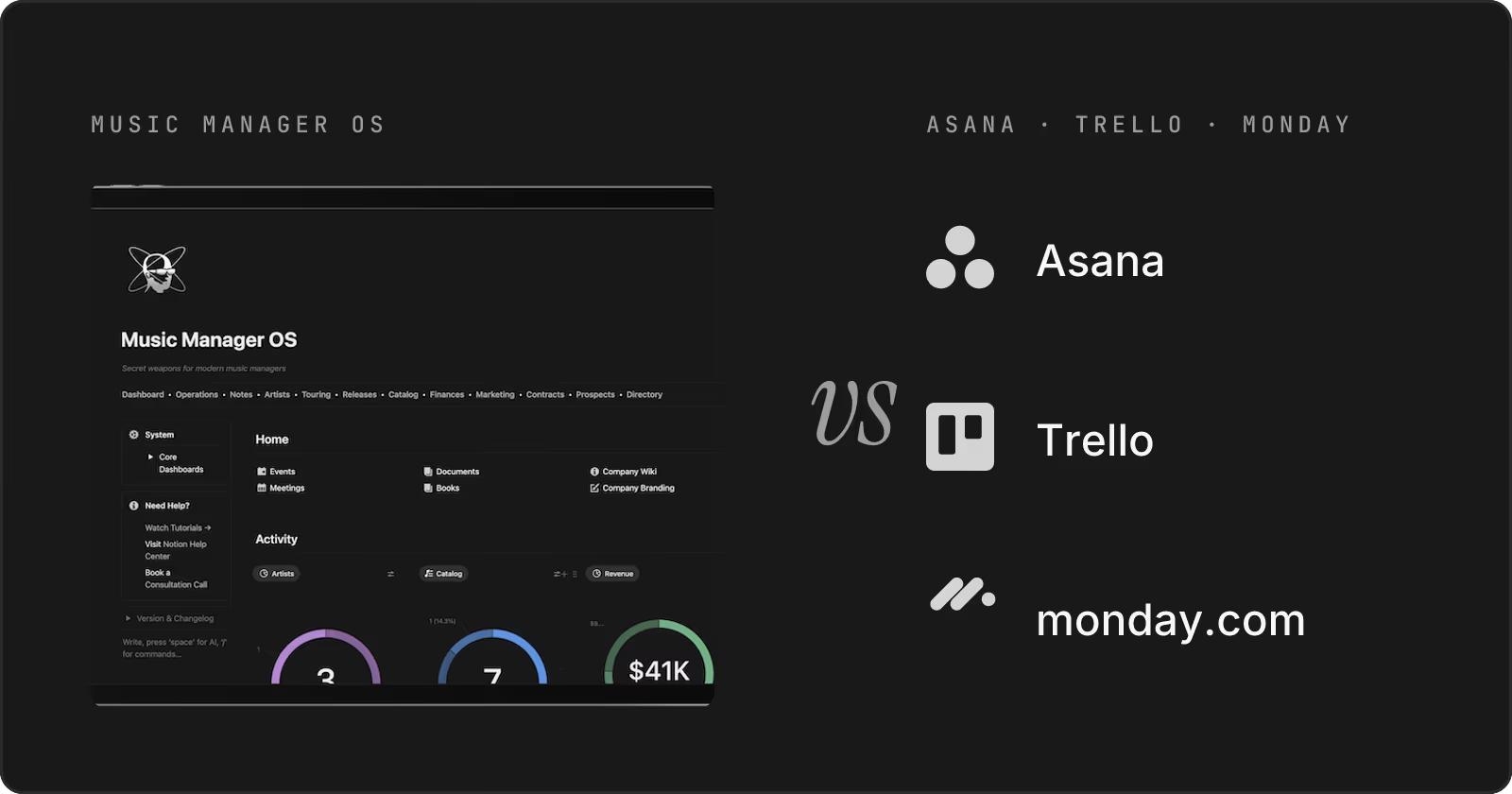
Asana, Trello and Monday are good software. They’ve refined task management to a degree no template ever will: subtasks, dependencies, workload views, a decade of polish. So this comparison begins with a concession that most “vs” articles bury: if your problem is purely who does what by when, buy one of them and stop reading. The reason artist managers keep churning off those tools is that management isn’t purely that problem, and the part left over happens to be the part that pays.
The short version: generic PM tools model work; artist management is mostly modelling things: artists, deals, catalogs, prospects, money. Music Manager OS is built around those entities, costs US$145 once instead of per-seat-per-month forever, and has managers operational inside half an hour.
The entity problem
Open Asana and try to add your roster. There’s no “artist”. There’s a project called the artist’s name, and immediately the abstraction leaks: where do the artist’s contract terms live? Their catalog and splits? The prospect you’re courting who has no project yet because there’s no work, only a relationship? PM tools have one noun, the task, plus folders to group it. Management runs on a dozen nouns, and tasks are the least interesting of them.
Music Manager OS models the nouns directly: eleven components covering Operations, Notes, Artists, Touring, Releases, Catalog, Finances, Marketing, Contracts, Prospects and Directory. An artist is a record; their releases, contract, tour dates and finances relate to it. The task list exists too, but it hangs off the entities rather than pretending to be them.
Side by side
| Music Manager OS | Asana / Trello / Monday | |
|---|---|---|
| Price | $145 once, lifetime updates | ~$5–24 per user/month (Monday: 3-seat minimum) |
| Three-year cost, 2 people | $145 | Roughly $360–$1,700 depending on tool and tier |
| Models artists, contracts, catalog | Natively, as connected databases | No; projects and cards standing in |
| Task management | Included, entity-linked | Best-in-class |
| Roster finances and royalties | Built in | Not present |
| Team features (workload, timelines) | Notion-level | Deeper, more polished |
| Setup | 15–30 minutes to operational | Minutes for tasks; the entity layer never arrives |
| Rating | 4.8 from 23+ reviews | n/a |
Where the PM tools honestly win
Pure task coordination at team scale. Assignments, dependencies, workload balancing across staff and contractors: this is their core competency and it is genuinely excellent.
Cross-company collaboration. If you’re plugged into a label’s or promoter’s existing Asana, meeting them where they work beats making them learn your system.
Automation and integrations. Mature ecosystems, native integrations, enterprise features like SSO. A larger office with IT requirements may simply need them.
None of that is roster management, though. It’s team management, and if that’s your actual bottleneck, buy the right tool for it, possibly alongside this one.
Where Music Manager OS wins
It speaks the job’s language. Prospects to courted, artists to signed, releases to shipped, contracts to renewal dates, commissions to collected. Nothing has to be translated into “card” or “board” first.
The economics. One mid-tier PM seat costs more per year than this system costs once. Managers run thin margins on developing artists; recurring per-seat software is exactly the overhead that thins them further.
One source of truth. The roster, its money, its deals and its deadlines in one workspace, rather than tasks in one tool and truth in a spreadsheet. And like every ThorneLabs system, it deliberately ships with more components than a young roster needs, because trimming beats retrofitting.
The verdict
If your office’s pain is task chaos across many people, a PM tool solves it and we’d be lying to claim otherwise. If your pain is that the actual business, the artists, deals, catalogs and money, lives in your head and seventeen tabs, that’s the entity problem, and no amount of Kanban solves an entity problem. Music Manager OS was built by people who managed real rosters and got tired of pretending an artist was a project. US$145, once, and the live demo shows you the whole thing before you decide.
Competitor pricing referenced from public listings as of August 2026; confirm at asana.com, trello.com and monday.com.
Frequently asked questions
Can I manage music artists with Asana or Trello?
You can run the task layer of management there, and plenty of managers do. What those tools can't represent is the entity layer: artists, catalogs, contracts, royalties and prospects are not tasks, and modelling them as cards or projects means the real data lives in your head or a separate spreadsheet. That's the gap a music-specific system closes.
How much do Asana, Trello and Monday cost compared to Music Manager OS?
As of 2026, Asana Starter runs about US$11 per user per month billed annually, Trello Standard about $5 and Premium $10, and Monday roughly $12 to $24 per user with a three-seat minimum. Music Manager OS is US$145 once, on Notion's free plan, with lifetime updates. A two-person management office on mid-tier plans spends more than $145 in the first year alone.
What's actually inside Music Manager OS?
Eleven connected components: Operations, Notes, Artists, Touring, Releases, Catalog, Finances, Marketing, Contracts, Prospects and Directory, unpacking into 30+ dashboards and 30+ templates. It's rated 4.8 from 23+ reviews, and most managers are operational within 15 to 30 minutes of duplicating it.
When is a generic project tool the right choice for a manager?
When your bottleneck is genuinely task coordination across a bigger team: staff, assistants, contractors all needing assignments, deadlines and workload views. Those tools are excellent at that. Some management offices run both: a PM tool for team tasking, and a system like Music Manager OS as the source of truth for the roster.